ALICE Technologies
AI construction-scheduling platform that simulates and optimizes project sequences, deployed on over $297 billion in construction projects globally.
ALICE Technologies is AI-driven construction scheduling and optioneering software founded in 2015, spun out of research at Stanford University, built around the idea of generating and comparing thousands of possible construction schedules automatically rather than relying on a single manually-built CPM schedule. The company's name is an acronym -- Artificial Intelligence Construction Engineering -- reflecting its origin as an academic research project focused specifically on applying combinatorial optimization to construction sequencing.
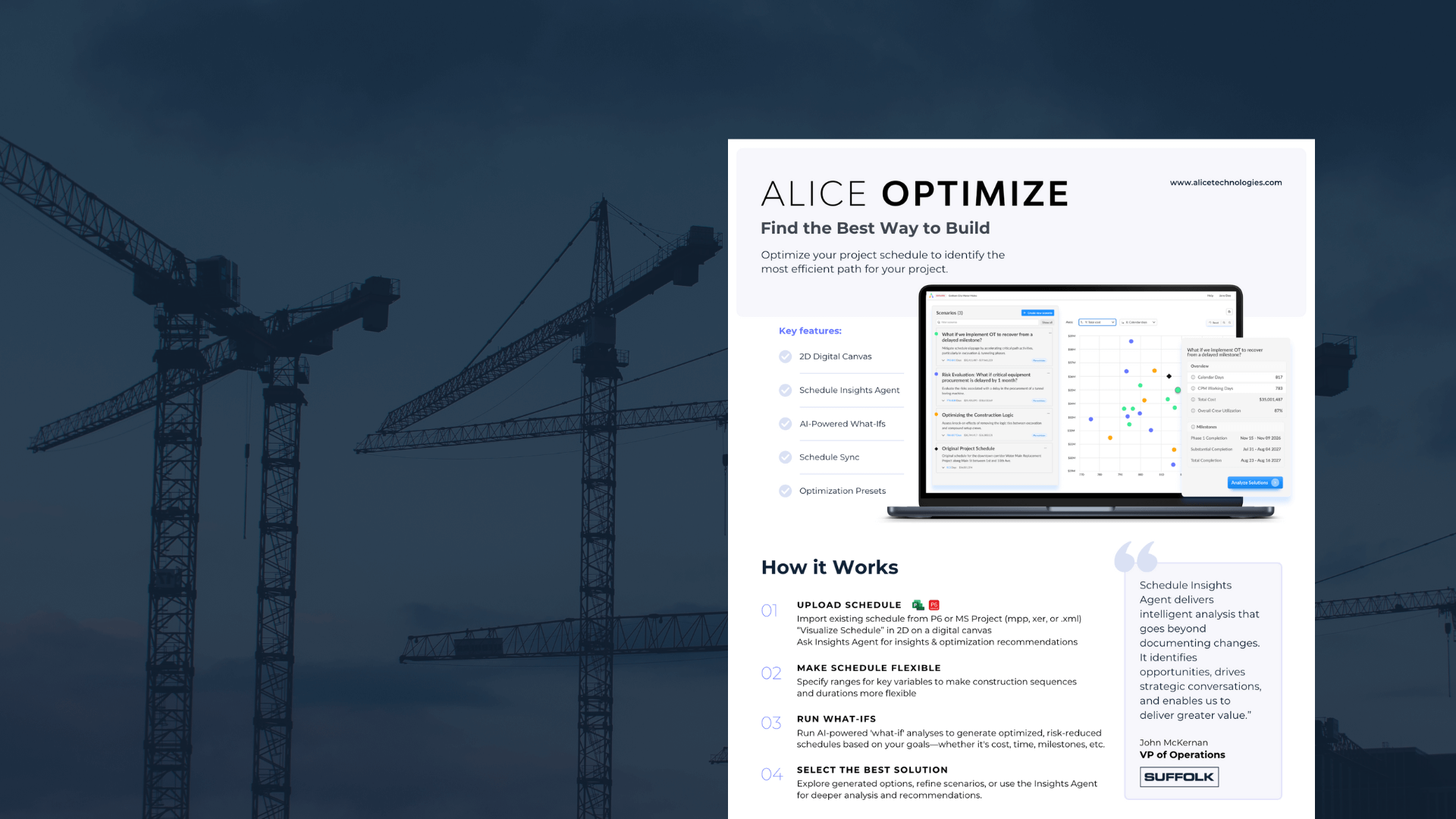
The core technology takes a project's scope, resources and constraints as inputs, then generates a large number of viable schedule options automatically, letting planners compare tradeoffs (cost versus duration versus resource loading) across options that would be impractical to construct manually one at a time -- a genuinely different approach from traditional CPM scheduling tools like Primavera P6, which optimize and manage a single schedule rather than generating and comparing many alternatives.
That optioneering capability is aimed specifically at preconstruction and early-planning decisions, where the cost of exploring more scheduling alternatives is low but the payoff (finding a genuinely better sequencing/resourcing strategy before breaking ground) can be substantial on large, complex projects.
The company has raised significant venture funding and named users include major contractors and infrastructure programs, with ALICE stating its platform has been deployed on over $297 billion in construction projects globally -- reflecting adoption specifically among large, complex projects (transportation, major vertical construction) where the cost of a suboptimal schedule is high enough to justify AI-driven optioneering during preconstruction.
Because ALICE generates options by exploring combinations of sequencing, crew allocation and resource-loading decisions systematically, it can also surface schedule risks that might not be obvious from a single manually-built schedule -- for example, revealing that a seemingly reasonable crew-allocation plan creates a resource bottleneck at a specific point that only becomes visible once compared against dozens of alternative allocation strategies side by side.
The platform has also extended its optioneering approach into ongoing schedule-recovery scenarios during construction itself, not just preconstruction planning -- when a project falls behind schedule, ALICE can generate and compare recovery-schedule options (adding shifts, re-sequencing remaining work, reallocating crews) faster than manually reworking a single CPM schedule from scratch.
Editor’s takeBIM•STACK editor's take: ALICE's Stanford-research origin and its genuinely novel approach -- generating and comparing many schedule options automatically rather than managing one -- position it as a preconstruction optimization layer that complements, rather than replaces, a CPM scheduling tool like Primavera P6 for ongoing project execution. It's most valuable specifically during early planning on large, complex projects where schedule optionality has real financial stakes; smaller or more straightforward projects likely won't see proportional value, and pricing requires a direct sales conversation.
ALICE's core concept -- generating many schedule options and comparing tradeoffs -- requires a shift in mindset for schedulers used to building and refining a single CPM schedule, since the tool asks planners to think in terms of exploring a solution space rather than iterating on one plan.
Planners and preconstruction teams with strong existing scheduling and cost-estimating fluency generally adapt fastest, since interpreting the tradeoffs between generated options meaningfully still requires that underlying domain expertise -- the AI generates and compares options, but a human still needs to judge which tradeoffs matter most for a given project.
Setting up a project's initial input model (scope breakdown, resource constraints, crew productivity rates) accurately is the most consequential part of the learning process, since the quality and realism of ALICE's generated options depends directly on how well that underlying input model reflects real project constraints -- firms typically improve their input-modeling accuracy across successive projects as they build internal expertise.
- Large, complex projects during preconstruction planningOptioneering delivers the most value when schedule/resourcing tradeoffs have real financial stakes.
- Contractors and owners wanting to explore scheduling alternatives systematicallyGenerates and compares options that would be impractical to build manually one at a time.
- Major infrastructure and transportation programsNamed users reflect strongest fit at that scale and complexity.
- You need ongoing CPM schedule management during executionPrimavera P6 remains the standard for managing a single schedule through construction, complementing rather than replacing ALICE.
- You need published, self-serve pricingCompare against tools with transparent tiered pricing if a custom sales conversation isn't feasible for your timeline.
- Your projects are small or straightforward enough for manual schedulingThe optioneering approach delivers proportionally less value at that scale.
What does ALICE stand for?
Artificial Intelligence Construction Engineering.
What is ALICE Technologies used for?
AI-driven generation and comparison of thousands of possible construction schedule options, primarily for preconstruction planning.
How much does ALICE cost?
Pricing isn't published -- contact sales directly for a quote.
Where did ALICE come from?
It was founded in 2015, spun out of Stanford University research into combinatorial optimization for construction sequencing.
Is ALICE a replacement for Primavera P6?
No -- ALICE focuses on preconstruction optioneering, while Primavera P6 manages ongoing CPM scheduling during execution; the two are complementary.