FARO
3D laser scanning hardware and software for as-built documentation.
FARO (FARO Technologies) is a publicly traded (Nasdaq: FARO) 3D measurement, imaging and reality-capture hardware company founded in 1981 by Simon Raab and Greg Fraser, headquartered in Lake Mary, Florida, with a product line spanning laser scanners, portable measurement arms and 3D documentation tools used across AEC, manufacturing, public safety and other industries.
In AEC specifically, FARO's laser scanners (the Focus series and others) are widely used for capturing accurate point-cloud data of existing buildings and sites, competing directly with Leica Geosystems' scanning hardware, also in this catalog, on overlapping use cases -- as-built documentation, renovation planning, and construction verification against design models.
FARO's broader business beyond AEC (manufacturing quality inspection, public-safety/forensic 3D scene documentation) reflects a diversified measurement-technology company rather than one purely focused on construction, giving it a large installed base and substantial R&D investment across multiple industries that carries over into continued development of its AEC-relevant scanning hardware.
Companion software (SCENE and related tools) handles point-cloud registration, processing and management from FARO's scanning hardware, giving firms an integrated hardware-plus-software pipeline similar in structure to Leica's own Cyclone ecosystem, with captured data ultimately flowing into BIM/CAD tools for design and construction use.
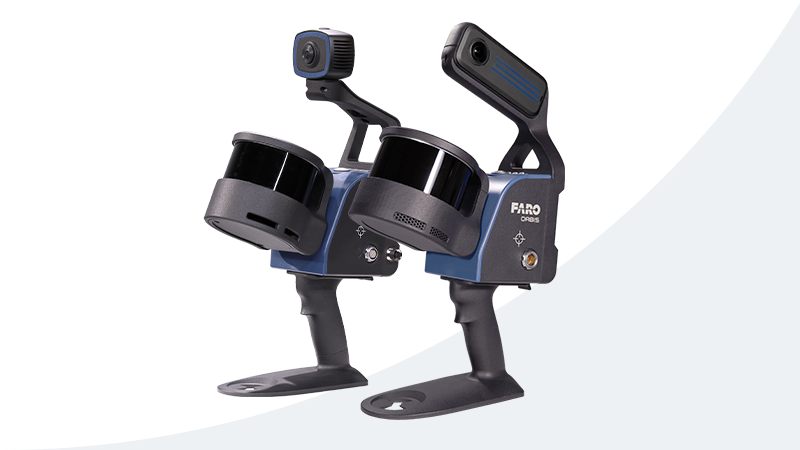
FARO's product range also spans handheld and portable scanning devices (like the Freestyle series) alongside its larger tripod-mounted Focus scanners, giving firms a choice of form factor depending on whether a specific capture task prioritizes maximum accuracy over a wider area (favoring a tripod-mounted scanner) or speed and portability for tighter, more accessible spaces (favoring a handheld device).
Beyond AEC, FARO's forensic and public-safety 3D scene-documentation product line (used for accident reconstruction and crime-scene documentation) reflects the same underlying scanning technology applied to a very different use case, underscoring how the company's core measurement-accuracy R&D investment serves multiple industries simultaneously rather than being AEC-specific engineering alone.
Editor’s takeBIM•STACK editor's take: FARO's four-decade history and public-company scale give it real staying power and continued R&D investment in reality-capture hardware, making it a credible direct alternative to Leica Geosystems for AEC laser-scanning needs. As with Leica, the actual choice between FARO and its competitors comes down to comparing specific scanner models on accuracy, speed, portability, and cost against your project's exact requirements, since this is fundamentally a capital-equipment decision rather than a simple software subscription choice.
Operating FARO's scanning hardware in the field requires proper training specific to laser-scanning technique, a genuinely different skill set than general BIM/CAD software use, typically requiring dedicated training or a specialist role.
Companion processing software (SCENE) has its own workflow for registering and cleaning up scan data before export to a BIM/CAD environment, adding a further, moderate learning investment beyond the hardware operation itself.
Firms choosing between FARO's handheld and tripod-mounted scanner form factors should expect a somewhat different field-operation learning curve for each -- handheld devices are generally quicker to pick up for continuous-walk capture, while tripod-mounted scanners require learning proper scan-position planning to ensure adequate overlap and coverage across a full site.
- Firms needing accurate reality-capture for as-built documentationLaser-scanning hardware suited to renovation planning and construction verification against design models.
- Organizations wanting a diversified, publicly traded hardware vendorFour decades of measurement-technology R&D investment across multiple industries.
- Firms wanting an integrated hardware-plus-software reality-capture pipelineAvoids sourcing scanning hardware and processing software from entirely separate vendors.
- You want to directly compare scanning hardware optionsLeica Geosystems offers a comparable range of laser scanners worth evaluating side by side on your specific project requirements.
- You need a lighter, more accessible capture methodMatterport's camera-and-smartphone-based capture is far less capital-intensive than survey-grade laser scanning.
- You only need downstream point-cloud processing, not scanning hardwareAutodesk ReCap processes point-cloud data from various scanner brands for BIM/CAD import.
What is FARO used for?
Manufacturing laser scanners and 3D measurement/documentation hardware, plus companion point-cloud processing software, used across AEC, manufacturing and other industries.
Who founded FARO Technologies?
Simon Raab and Greg Fraser founded it in 1981, headquartered in Lake Mary, Florida.
How much does FARO scanning hardware cost?
Pricing isn't published -- requires a direct sales or reseller conversation.
Is FARO publicly traded?
Yes -- listed on Nasdaq under the ticker FARO.
How does FARO compare to Leica?
Both are established laser-scanning hardware makers; firms typically compare specific models on accuracy, speed, portability and cost for their exact project needs.