Archicad
Powerful BIM software built for architects who value design and efficiency.
Archicad is a BIM authoring application developed by Graphisoft, a Hungarian software company founded in 1982 and now part of the Nemetschek Group. It is widely credited as the first BIM software for personal computers, predating Autodesk Revit by roughly a decade, and it remains one of the two dominant full-featured BIM platforms for architects alongside Revit. Its user base skews toward small firms -- small architecture, construction, and civil engineering businesses with up to 50 employees make up the bulk of adoption.
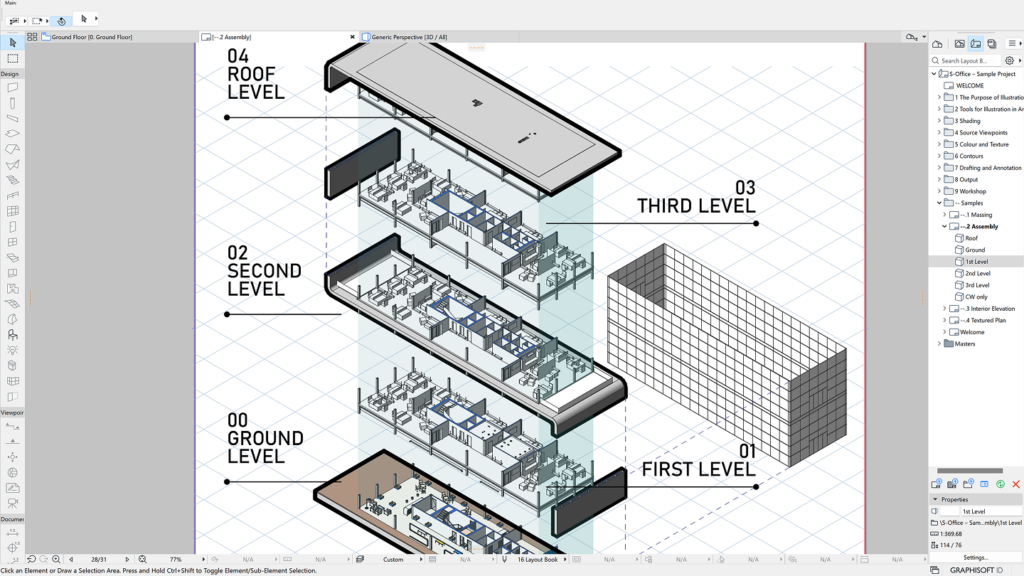
Archicad's reputation is built largely on being architect-first software: intuitive, with a tightly integrated 2D/3D workflow where drawings, 3D models, and schedules stay linked. It's generally considered easier to use, set up, and administer than Revit, though Autodesk's feature roadmap and ecosystem breadth are typically seen as stronger.
Geographically, Archicad's strength is uneven. European usage research shows Autodesk's Revit and AutoCAD together dominate roughly 80-90% of the European BIM/CAD market, with Archicad the clear runner-up, used as BIM software by roughly a third of architects there. In the U.S., Archicad's footprint is considerably smaller than Autodesk products.
One of Archicad's most distinctive strengths is its long-standing native macOS support. Archicad runs as a true native Mac application (no Parallels or Boot Camp required) and was one of the applications Apple chose to demonstrate at its 2023 M3 MacBook Pro launch event, underscoring Graphisoft's continued investment in Apple Silicon -- a niche Revit (Windows-only) cannot serve.
Archicad's founder, Gábor Bojár, built the product on the concept of a 'Virtual Building' -- a single intelligent 3D model from which drawings, schedules, and visualizations are all derived -- years before the term BIM became standard industry vocabulary, which is part of why Archicad is often credited as the conceptual predecessor of the modern BIM category. Graphisoft has also been a founding member of the buildingSMART alliance behind the IFC open-data standard, and that early, sustained commitment to Open BIM interoperability still shapes Archicad's product priorities today, from its own IFC4 certification to its emphasis on exchanging models cleanly with Revit, Tekla, and other platforms on multidisciplinary projects.
The product ships one major version annually, typically announced around mid-year, and recent releases have centered on Teamwork/BIMcloud performance, expanded MEP modeling depth, and tighter integration of Graphisoft's PARAM-O visual scripting environment for custom parametric objects -- Archicad's rough equivalent to Revit's Dynamo or Rhino's Grasshopper, aimed at studios that want to build their own custom, rule-based components without writing a full plugin.
As a sibling brand under the Nemetschek Group alongside Vectorworks, Bluebeam, and other AEC software makers, Archicad occupies a distinct niche within that portfolio: it's Nemetschek's flagship architecture-first BIM authoring platform, positioned to compete head-on with Revit rather than serve the broader cross-discipline role Vectorworks plays across landscape and entertainment design.
On the technical side, Archicad's Teamwork/BIMcloud collaboration system is a genuine differentiator worth understanding on its own terms: rather than locking an entire central model while one user saves changes, it uses element-level reservations and delta-based synchronization, so multiple people can work on different parts of the same building simultaneously and only the specific changes -- not the whole file -- are transmitted between the server and each user's machine. That architecture is part of why Archicad's collaboration tools are frequently described as working reasonably well even over lower-bandwidth or geographically distributed office connections, a real consideration for firms with remote staff or satellite offices that don't all sit on the same high-speed local network.
Archicad is regarded as easier to pick up than Revit, generally rated ahead of Revit specifically on ease of use, ease of setup, and ease of administration -- attributed to a more design-centric, less parametric-family-driven interface.
That said, 'smoother than Revit' is a relative bar, not evidence Archicad is simple. Graphisoft's own community forums and certification programs exist because there's a genuine ramp-up period, particularly around Teamwork/BIMcloud setup, library management, and getting large projects to perform well.
New users typically reach basic drafting and modeling competency faster than in Revit, since Archicad's toolset maps more directly onto familiar architectural elements (walls, slabs, stairs, roofs) without requiring the same upfront investment in understanding parametric families. The steeper part of the curve tends to arrive later, once a studio moves into custom object creation with PARAM-O, configures Teamwork/BIMcloud for multi-user projects, or needs to optimize a large, library-heavy model for performance -- areas where Graphisoft's own documentation, certified trainers, and regional resellers are the main support resources firms lean on.
- Small to mid-sized architecture firmsArchicad's user base is dominated by small architecture, construction, and civil engineering businesses with up to 50 employees.
- Mac-based design studiosFirms standardized on Apple hardware benefit from Archicad's native macOS support and Apple Silicon optimization.
- Design-focused practices prioritizing visualizationWith CineRender, Redshift, and AI Visualizer built in, Archicad suits studios wanting strong in-house rendering without a separate pipeline.
- European, Australian, and Open-BIM-oriented firmsArchicad has meaningfully stronger market share and IFC4/Open BIM interoperability in Europe and Australia.
- Teams needing simpler collaboration without heavy IT overheadBIMcloud's Basic tier ships free with every license and works well even on modest office IT setups.
- You need maximum job-market compatibility in North AmericaOver 70% of AEC job listings worldwide request Revit skills specifically -- the safer choice for U.S. hiring and government/commercial client requirements.
- You're doing large-scale, multidisciplinary institutional projectsArchicad's collaboration and automation tools can become less efficient at the largest institutional scale, where Revit's tools are generally considered stronger.
- You depend heavily on third-party pluginsRevit's plugin ecosystem is significantly larger and more mature than Archicad's add-on marketplace.
- You're a small firm wanting an even gentler entry pointVectorworks Architect is frequently positioned as a lower-cost, design-oriented alternative worth evaluating for smaller-scope practices.
- You primarily exchange files with AutoCAD-based consultantsFirms whose consultant network is heavily AutoCAD/Revit-based may find Revit's native DWG/RVT ecosystem reduces file-translation headaches.
How much does Archicad cost in 2026?
Graphisoft sells Archicad only by subscription. Pricing runs roughly $201/month ($2,414/year) for Archicad Studio billed annually, and roughly $237/month ($2,840/year) for Archicad Collaborate, which adds BIMcloud SaaS and MEP features.
Is Archicad better than Revit?
It depends on context. Archicad is generally easier to use, set up, and administer, while Revit has a broader feature roadmap and ecosystem. Revit has broader job-market demand and a larger plugin ecosystem; Archicad has stronger Mac support and built-in rendering.
Does Archicad run well on Mac?
Yes -- Archicad is a native macOS application optimized for Apple Silicon, requiring no virtualization software. Apple selected Archicad to demonstrate performance at its 2023 M3 MacBook Pro launch.
How steep is Archicad's learning curve?
Generally described as smoother than Revit's, largely due to a more design-oriented interface, though it's still a full BIM platform requiring real ramp-up time, especially for collaboration setup and large-project optimization.
Is Archicad in high demand for jobs?
Less so than Revit globally. Revit is requested in over 70% of AEC job postings worldwide, with Archicad demand concentrated in Europe, Australia, and smaller studios.
Can Archicad handle large, complex projects?
It can, but performance slowdowns on very large multi-building projects are documented on Graphisoft's Community forum, often tied to library size and default settings that Graphisoft publishes optimization guidance for.