TestFit
AI-powered feasibility and massing studies for real estate and multifamily.
TestFit is a real-estate feasibility platform founded in October 2015 in Dallas by Clifton Harness (an architecture graduate frustrated by manually drawing apartment unit mixes and counting parking stalls) and his college roommate Ryan Griege (a software developer). The first version was a command-line tool with no interface, built to solve unit-mix math; TestFit released its generative design tool publicly in October 2017 and was built from scratch rather than on top of Grasshopper or Dynamo, specifically so it could generate site plans in real time.
What started as a multifamily-only tool has expanded into mixed-use, single-family, industrial, retail, hotel, parking and data-center typologies. A user enters site and program parameters and TestFit's engine -- running well over 100 parameters and dozens of algorithms -- generates a buildable site plan with unit mix, parking layout, massing and a real-time financial pro forma, editable down to individual parking stalls. Direct integrations connect it to Revit, AutoCAD, SketchUp, Zoneomics zoning data, ESRI environmental data, and an MCP connection for prompting site plans through an AI assistant.
TestFit positions itself squarely as a pre-design feasibility tool, not a BIM or documentation platform -- developers use it to kill bad deals quickly and validate financial assumptions, architects use it to respond to sites faster and win fee proposals, and general contractors and civil engineers use it for early cost, quantity and grading insight, before handing a validated concept off to Revit, AutoCAD or SketchUp for detailed design.
Its own CEO has been notably candid about the tool's limits: TestFit is deterministic, meaning it produces a solution that satisfies the input constraints, not necessarily the best possible one, and there's no promise of finding an objectively optimal design. He's also cautioned against students and junior architects relying on it before they understand why a building is designed the way it is -- someone still needs to know why walls, parking counts and vertical circulation work the way building codes require.
Getting a usable first site plan out is fast -- customers describe sizing up a site in around 10 minutes. Going deeper into TestFit's manual/co-creation tools, unit configurator, and pro forma customization takes longer, and dedicated onboarding with an account manager is only included on the higher-priced Site Solver plan; Parking Solver customers rely on online training resources and email support.
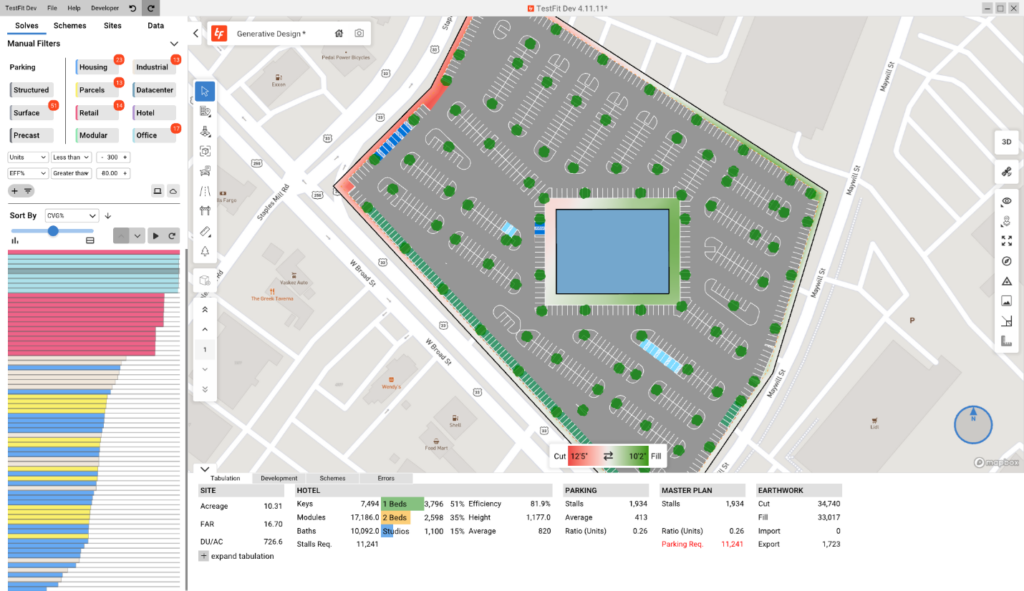
- Real estate developers vetting deals quicklyThe core use case TestFit was built around -- killing off deals that don't pencil out before spending real design time on them.
- Architecture firms responding fast to sites and RFPsFirms use TestFit to generate viable options quickly and win design fees by responding to clients faster.
- Multifamily-focused development and design teamsTestFit's original and still-strongest typology, with the deepest unit-mix and parking automation.
- GCs and civil engineers needing early cost and grading insightReal-time cost estimates, quantity takeoffs, and cut/fill and grading validation happen before construction drawings exist.
- You need full BIM authoring and construction documentationTestFit hands off to Revit, AutoCAD or SketchUp for that -- it isn't a substitute for them.
- You want early massing and site analysis without a typology-licensed toolAutodesk Forma's Site Design covers massing, solar/wind and zoning feasibility as part of a broader Autodesk subscription many firms already have.
- Your budget can't stretch to Site Solver's enterprise pricingConfirm which typologies and features you actually need against the Parking Solver plan's limits before assuming you'll need the $15,000+/year tier.
How much does TestFit cost?
Parking Solver starts at $195/month for parking automation and 2D/3D massing. Site Solver, which adds generative design, custom unit types and detailed typology presets, starts at $15,000/year, and Site Solver Portfolio (with volume pricing and enterprise SSO) starts at $20,000/year.
What building typologies does TestFit support?
Multi-family, single-family, industrial, retail, hotel, parking and data center, in addition to mixed-use developments.
Is TestFit a BIM tool?
No -- it's a pre-design feasibility and generative massing tool. Detailed BIM authoring and construction documentation happen afterward in Revit, AutoCAD or SketchUp, all of which TestFit integrates with directly.
Who founded TestFit?
Clifton Harness and Ryan Griege co-founded TestFit in October 2015 in Dallas, releasing the public generative design tool in October 2017.
Does TestFit find the optimal building design?
No -- by its own CEO's description, TestFit is deterministic and generates a solution that satisfies the input parameters, not necessarily the single best design possible. It's built for fast iteration, not to replace design judgment.
Does TestFit work outside the US?
Yes, globally, with the same core features -- though some data layers (flood zones, wetlands, zoning) may not be available in every country, and support/training are English-only during US business hours.


