Arcol
Browser-based, real-time collaborative building-design tool often described as "Figma for buildings."
Arcol is a browser-based building-design tool that gets pitched, both by outside press and by the company itself, as "Figma for buildings" -- a real-time, multiplayer canvas where several people can model, sketch and comment on the same building at the same time, the way a design team collaborates in Figma rather than the way architects have traditionally passed Revit files back and forth. That comparison isn't just marketing shorthand: Arcol's core architecture is built around the same real-time multiplayer infrastructure pattern that made browser-based design tools like Figma and Notion possible, applied to 3D building massing and early-stage design rather than 2D interface mockups or documents.
The company was founded in January 2021 by Paul O'Carroll, a self-taught programmer and design-studio founder with a political science background from UC Berkeley and UCLA rather than a traditional architecture or computer-science pedigree -- worth noting because some secondary sources have claimed the founding team came from Facebook/Instagram, a claim that doesn't appear anywhere in O'Carroll's own public history and should not be treated as fact. What is confirmed, via TechCrunch's own reporting, is the investor list: Arcol raised a $1.5M pre-seed round in 2021 followed by a $3.6M seed round in 2022, backed by Cowboy Ventures, Figma CEO Dylan Field, Figma's Lauren Martin, former Mozilla CEO John Lilly, Procore CEO Tooey Courtemanche, former Autodesk co-CEO Amar Hanspal (who has since gone on to found his own AEC AI company, Motif) and Not Boring's Packy McCormick. That investor roster reads like a deliberate signal: design-tool operators (Figma), AEC incumbents (Procore, Autodesk) and infrastructure/platform investors all placing a bet on the same browser-native thesis at once.
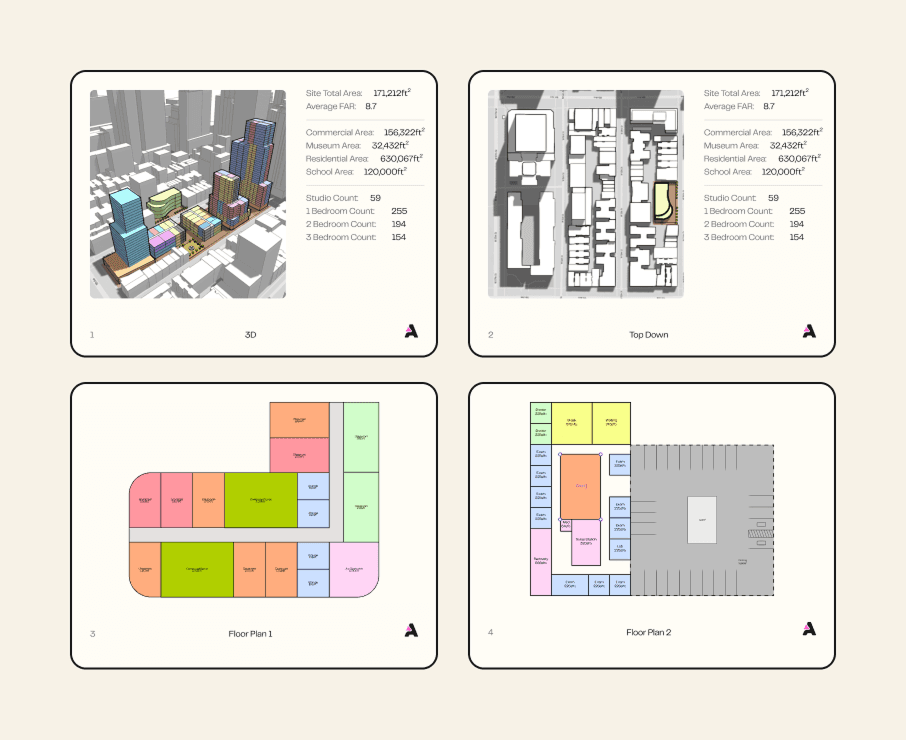
Functionally, Arcol converts rough 2D sketches into 3D massing studies inside the same collaborative canvas, and pulls in site context and zoning/parcel data automatically for North American sites -- letting a team see real setback and zoning constraints against a massing study without manually researching and re-entering that data for every site. Live-updating project metrics (areas, counts, and similar quantities that update automatically as the model changes) round out the pitch: rather than a separate schedule or takeoff step, the numbers a design team cares about during early massing stay current as the design itself changes in real time, visible to every collaborator in the same session.
Where Arcol is more limited than a full BIM platform is interoperability: the only vendor-confirmed integration is Revit export, available on the paid Team plan, and there's no public API or third-party plugin ecosystem documented on the official site as of this review. That's consistent with Arcol's own positioning -- it isn't trying to replace Revit for construction documentation, but to own the earlier, more exploratory massing-and-concept phase of a project, with Revit export as the hand-off point once a design moves into detailed BIM production. Firms should read Arcol's feature list on its own terms: sheet sets, project templates and a team project browser exist for organizing early design work, not as a substitute for a full documentation pipeline.
Pricing is genuinely simple compared to most of this category: a free Solo plan with no credit card required, and a single paid Team plan at $100 per user per month, billed monthly (an annual rate exists but isn't published outright, requiring a sales conversation). The Team plan adds unlimited collaborators and commenting, the automatic site-context and zoning data, Revit export, sheet-set templates, a dedicated customer success manager and personalized onboarding. There's no multi-tier pricing ladder to navigate -- either a single user tries it for free, or a team pays one flat per-seat rate for the full feature set.
On customer proof, Arcol maintains a /customer-stories page with named, quoted architecture firms -- Warren and Mahoney, SERA Architects, HCM Architects (whose principal Josh Tindall specifically cites 25% faster project delivery), Gorman & Company, CDH Partners, /slantis, GWWO and THW -- but as of this review no confirmed, hotlinkable logo images could be verified for those testimonials, so treat them as real, named references rather than a logo wall. Press coverage is more substantial than the company's size might suggest: beyond the 2022 TechCrunch launch piece, Arcol has been covered by AEC Magazine ("Arcol unleashed – BIM 2.0"), Engineering News-Record ("Arcol Brings BIM to a Browser, Gives Design Concept Choice") and Architosh's coverage of Arcol's presence at the AIA National conference in Boston in 2025 -- a reasonable spread of both general tech press and AEC-specific trade press taking the product seriously.
It's worth understanding Paul O'Carroll's own background a bit further, since it shapes why Arcol looks the way it does: before founding Arcol, he ran a design studio and taught himself to program rather than following the conventional path of an architecture degree followed by a computer-science pivot (or vice versa). That combination -- a working design practitioner's frustration with existing tools, paired with the technical ability to actually build a real-time collaborative canvas from scratch -- is a similar founder profile to a lot of successful vertical-software companies, where the person who felt the pain personally is also the one capable of shipping the fix. It also explains why Arcol's product decisions favor the messy, exploratory reality of early design (rough sketches becoming massing options, live metrics changing as a team argues over a design direction) rather than the more rigid, rule-based parametric modeling Revit is built around.
Arcol also sits in a increasingly crowded field of browser-native building-design startups -- Qonic, Snaptrude, Motif and others are all pursuing some version of cloud-native, collaborative BIM, each with a different specific bet about where in the project lifecycle to focus first. Arcol's bet is unambiguously on the earliest, most exploratory phase: massing, site feasibility and concept-level metrics, handed off to Revit once a project is ready for detailed documentation, rather than trying to own clash detection, construction documentation or facilities management the way a full BIM platform eventually needs to. That narrower scope is arguably a strength rather than a limitation for the specific job it's built for -- a tool trying to be excellent at real-time collaborative massing doesn't need to also solve MEP coordination, and firms evaluating it should judge it against that scope rather than against a full BIM platform's feature checklist.
Editor’s takeBIM•STACK editor's take: Arcol is at its best when evaluated as what it actually is -- a real-time collaborative massing and early-design tool, not a Revit replacement -- and the investor list (Figma's own CEO, plus sitting CEOs of Procore and a former Autodesk co-CEO) is a genuinely unusual vote of confidence from people who understand both the collaborative-software pattern and the AEC market it's being applied to. The flat, simple pricing is refreshing in a category full of custom quotes. The honest limitation is depth: once a project moves past massing into real construction documentation, Arcol hands off to Revit rather than trying to cover that ground itself, so it's best evaluated as a complement to an existing BIM pipeline rather than a wholesale replacement for it. Firms that run design competitions, early client workshops or fast-turnaround feasibility studies -- situations where several people genuinely need to explore massing options together in real time -- are the clearest fit; firms whose bottleneck is documentation speed or construction-phase coordination will get more value from investing in their existing BIM platform directly.
Arcol's learning curve is deliberately shallow by design, since the whole premise is borrowing an interaction model -- real-time multiplayer canvas editing -- that many users already know from Figma, Miro or Google Docs, applied to 3D massing instead of 2D interfaces or documents. Architects and designers who've used any modern collaborative design tool tend to find the core canvas, commenting and multiplayer editing intuitive within their first session, since Arcol isn't asking them to learn a new collaboration paradigm, just a new domain (3D building massing) for a familiar one.
The bigger adjustment isn't the software itself but the workflow change it implies: teams used to working in separate Revit files and merging changes through worksharing or manual coordination need to get comfortable with everyone editing the same live model simultaneously, which is a genuine process shift even when the software itself is easy to pick up. Because Arcol positions itself as an early-massing tool that hands off to Revit via export rather than trying to own the whole project lifecycle, most firms will treat it as an addition to their existing pipeline rather than a wholesale replacement -- which also means the learning curve is bounded: teams only need to learn Arcol's canvas and massing tools, not an entirely new documentation and construction-administration workflow, since that part of the job still happens in whatever BIM tool the Revit export feeds into. In practice, most teams report being productive with the core canvas within a single working session, with the real ramp-up time spent agreeing on team norms for live collaborative editing -- who models what, how comments get resolved, when a massing option gets exported to Revit -- rather than on mastering the software's own tools.
- Design teams doing real-time collaborative early massingThe multiplayer canvas is purpose-built for the concept and massing phase, where multiple stakeholders often want to explore options together live.
- Firms that already use Revit for documentationRevit export positions Arcol as a front-end complement to an existing Revit-based production pipeline rather than a replacement for it.
- Teams sensitive to complex, tiered software pricingA flat $100/user/month Team plan (or free Solo) is simpler to budget than the multi-tier, portfolio-sized pricing common elsewhere in this category.
- US/Canada-based site feasibility and zoning studiesThe automatic zoning/parcel data integration is most valuable for North American projects where that data pull-in is actually supported.
- Studios wanting live, shared design metrics during concept designLive-updating areas and counts suit teams that want to track project metrics collaboratively from the earliest design stages.
- You need full BIM authoring and documentation in one toolRevit, Archicad or Qonic cover the full modeling-to-documentation lifecycle that Arcol deliberately doesn't try to own.
- You need projects outside North America with local zoning dataArcol's automatic site-context data is North America-only, so international teams may get less value from that specific feature.
- You need a documented API or plugin ecosystemSnaptrude or Qonic publish more developer-facing integration surfaces if custom scripting or third-party tooling is a requirement.
- You want confirmed logo-based customer proof before buyingFirms requiring a vendor-hosted customer-logo wall as part of procurement should ask Arcol directly, since none is currently published.
- Your team has no Figma/collaborative-canvas experience at allTeams entirely unfamiliar with real-time multiplayer design tools may find the paradigm itself, not just Arcol specifically, an adjustment.
Who founded Arcol and when?
Arcol was founded in January 2021 by Paul O'Carroll. Claims that the founding team came from Facebook/Instagram are not supported by any confirmed source and should not be treated as fact.
How much has Arcol raised in funding?
Per TechCrunch's own reporting, Arcol raised a $1.5M pre-seed round in 2021 and a $3.6M seed round in 2022, backed by investors including Figma CEO Dylan Field and Procore CEO Tooey Courtemanche.
Is Arcol free to use?
Yes, a Solo plan is free with no credit card required. The Team plan costs $100 per user per month, billed monthly.
Does Arcol replace Revit?
No. Arcol is built for early-stage collaborative massing and concept design and exports to Revit (on the Team plan) for detailed BIM documentation, rather than trying to replace a full BIM authoring tool.
Does Arcol have an API?
Not as of this review -- no public API or third-party plugin ecosystem is documented on Arcol's official site. Revit export is the only confirmed integration.
Is Arcol's zoning and site data available outside the US?
No -- the automatic site-context, parcel and zoning data integration is explicitly limited to North America per Arcol's own feature list.

