Catenda Hub
OpenBIM common data environment (CDE) from Norway's Catenda (formerly BIMsync), priced per project rather than per seat.
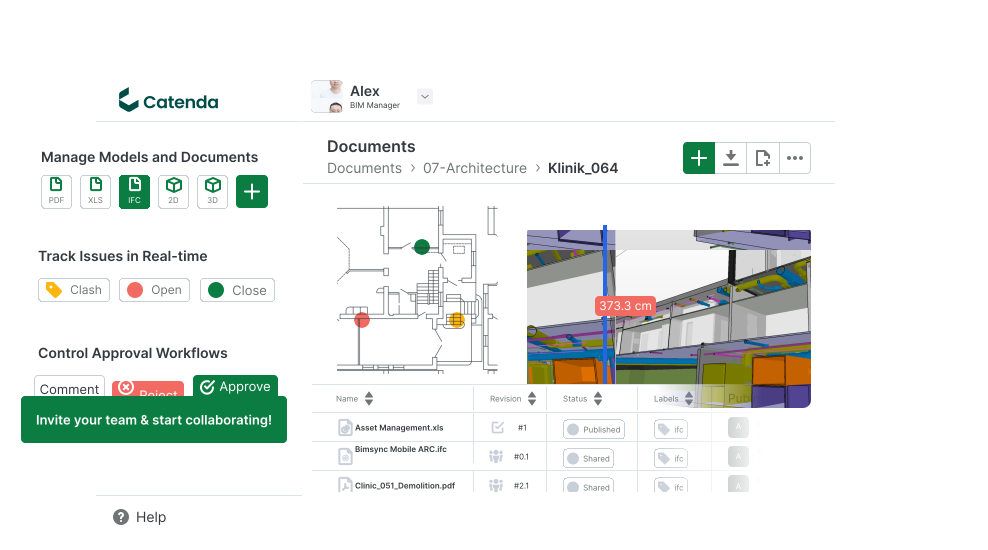
Catenda Hub is an openBIM common data environment from Catenda, a Norwegian company formerly known as BIMsync -- one of the longer-running names in the CDE space, with roots going back well before "openBIM" became a common industry term. Its core differentiator versus most CDE competitors is native IFC and BCF round-tripping (supporting BCF 2.1 and 3.0) as first-class citizens rather than an export afterthought, reflecting Catenda's long-standing openBIM-first positioning.
Pricing is structured unusually: rather than charging per user seat, Catenda Hub prices per project based on project value -- roughly €400/month for a €10M project, as an illustrative published example -- with a free, limited version also available. That model removes the incentive to restrict who gets invited to a project, and Catenda accordingly advertises unlimited user invitations per project, a meaningful difference from seat-based CDEs where adding every subcontractor and consultant gets expensive fast.
A newer feature, Catenda AI Connect, is built MCP-native (Model Context Protocol), letting AI agents and tools query and act on project data through a standardized interface rather than a proprietary API -- an early and fairly technical bet on the same agent-interoperability trend now showing up across the BIM software category. Catenda also emphasizes EU-based hosting, plus SSO and SCIM support at the Enterprise tier, both relevant for European public-sector and data-sovereignty-conscious clients.
The named customer list is a real, if compact, cross-section of European infrastructure and real estate: Schiphol (Amsterdam's international airport), Kajima (a major Japanese contractor with European operations), Bouygues Immobilier, Ten Brinke, Art-Invest Real Estate and Van Norel all appear as customers on Catenda's own site -- Schiphol in particular is a substantial, credible airport-infrastructure reference for a CDE vendor of Catenda's size.
Editor’s takeBIM•STACK editor's take: Catenda Hub's per-project rather than per-seat pricing is a genuinely useful model for projects with large, fluid subcontractor rosters where seat-based CDEs get expensive fast, and its openBIM-native architecture (rather than IFC bolted on) reflects real technical depth built up over a long history in this space. The MCP-native AI Connect feature is early but forward-looking. The main caveat for firms outside Europe is that Catenda's strongest reference customers and EU-hosting emphasis suggest it's most proven in European markets first.
Teams already comfortable with openBIM concepts (IFC, BCF) will find Catenda Hub's model straightforward, since the platform is built around those standards natively rather than around a proprietary format. The project-based pricing model requires an upfront conversation with Catenda to get an accurate quote rather than a simple self-serve signup, which adds a small amount of friction versus flat per-seat competitors, but pays off for projects with large, changing team rosters.
- Projects with large or fluid subcontractor rostersUnlimited user invitations per project remove the per-seat cost penalty of a large, changing team.
- Firms committed to openBIM/IFC workflowsNative IFC and BCF round-tripping suit vendor-neutral, standards-based project delivery.
- European public-sector and data-sovereignty-conscious clientsEU-based hosting and Enterprise-tier SSO/SCIM directly address those requirements.
- Teams exploring AI-agent integration with project dataCatenda AI Connect's MCP-native design is an early, technically serious bet on this trend.
- You want simple, predictable per-seat pricingBIMcollab or Trimble Connect price per user rather than per project value.
- Your team isn't openBIM-focusedA CDE with broader native-format support beyond IFC/BCF may fit better.
How is Catenda Hub priced?
Per project based on project value -- roughly €400/month for a €10M project as a published example -- rather than per user seat. A free limited version is also available.
What was Catenda called before?
Catenda was formerly known as BIMsync.
Does Catenda Hub support openBIM standards?
Yes -- native IFC and BCF 2.1/3.0 round-tripping are core to the platform, not an export-only feature.
Who uses Catenda Hub?
Named customers on Catenda's own site include Schiphol, Kajima, Bouygues Immobilier, Ten Brinke, Art-Invest Real Estate and Van Norel.
What is Catenda AI Connect?
A newer feature built MCP-native (Model Context Protocol), letting AI agents and tools query and act on project data through a standardized interface.

