Higharc
AI-native design-to-construction platform for homebuilders that generates homes as 3D spatial data, automating design, estimating and construction documentation.
Higharc is an AI-native design-to-construction platform built specifically for homebuilders, generating homes as 3D spatial data rather than static 2D drawings so that a single underlying model can drive design, sales visualization, cost estimation, and permit-ready construction documentation simultaneously. The pitch is architectural: when a buyer changes a selection or a builder adjusts a lot-specific detail, every downstream artifact -- the rendering, the takeoff, the construction set -- updates automatically rather than requiring separate manual rework in each discipline.
The product spans the full homebuilding workflow through named modules: Studio for designing homes from scratch, Config for configuring market-proven plans against buyer selections, Showroom for turning a home into shoppable 3D visuals for sales, Estimate for generating plan-based material takeoffs and cost estimates, Build for producing permit-ready construction documents, and Photoreal for generating photorealistic renderings -- plus an AI Estimating capability aimed specifically at building-material distributors needing takeoffs at enterprise scale.
On June 30, 2026, Higharc announced a $95 million Series C led by Insight Partners, with participation from Wellington Management, Fifth Wall, Spark Capital, Lux Capital, and SE Ventures, bringing total funding to more than $170 million -- a substantial round that signals strong institutional confidence in AI-native homebuilding software specifically. Alongside the raise, Higharc announced a strategic partnership with US LBM, the largest private distributor of lumber and building materials in the United States, extending Higharc's platform into the building-materials supply chain rather than remaining purely a builder-facing design tool.
Reported customer results are substantial if vendor-sourced: a 15% margin increase, 50% reduction in time to open new communities, 80% faster product development, and 75% faster soft-cycle time. Those figures should be read as vendor-reported outcomes from specific customer engagements rather than universal guarantees, but the range and specificity of the claims (spanning margin, speed-to-market, and cycle time) suggest genuine operational impact across multiple builder use cases rather than a single cherry-picked metric.
The enterprise AI Estimating capability aimed at building-material distributors is a notable expansion of Higharc's addressable market beyond builders themselves -- distributors sit downstream of the same underlying spatial-data model, and giving them a direct estimating tool tied to that data creates a second, genuinely different customer type (materials supply chain rather than design/construction) that the company can serve from the same core platform investment.
Higharc's named customer base includes Signature Homes, Ashlar Homes, New Home Inc., Legacy Design Homes, United Built Homes, Buffington Homes, and Epcon Communities -- spanning independent regional builders through larger production homebuilders, consistent with the company's positioning as serving "homebuilders of various sizes." The company's rapid growth earned it a spot in the top 50 of the Deloitte Technology Fast 500 and recognition on Fast Company's Most Innovative Companies list for 2026.
Editor’s takeBIM•STACK editor's take: Higharc's core architectural idea -- one underlying 3D spatial model driving design, sales visualization, estimating and construction documentation simultaneously -- is a genuinely coherent answer to a real homebuilding pain point, where those four functions are traditionally disconnected, manually-synced processes prone to costly mismatches between what's sold and what's actually buildable. The $95M Series C and the US LBM supply-chain partnership are strong external validation signals. The honest caveat is that pricing is entirely unpublished, so firms should expect a sales-led evaluation process rather than transparent, comparable tiered pricing.
Higharc's Config module in particular is built around a configurator-style workflow -- selecting and adjusting market-proven plans against buyer preferences -- which is generally more approachable for sales and design staff than learning a full parametric BIM authoring tool from scratch, since the underlying plan library does much of the heavy lifting. Teams using Studio to design homes from scratch face a steeper curve than teams primarily configuring existing plans.
Because Higharc's value proposition depends on one model driving multiple downstream outputs (sales visuals, estimates, construction documents), the more significant organizational learning curve is often process-related rather than purely technical -- getting design, sales and construction teams to actually rely on the same underlying model rather than maintaining separate, disconnected files requires real workflow change management, not just software training.
Builders new to spatial-data-driven homebuilding (as opposed to traditional static 2D plan sets) also need to adjust to a genuinely different mental model of what a "finished" home design actually is -- rather than a fixed drawing set, it's a living, parametrically adjustable dataset that keeps regenerating downstream outputs as buyer selections or lot conditions change, which takes a real conceptual shift for teams used to treating a plan set as a static, one-time deliverable.
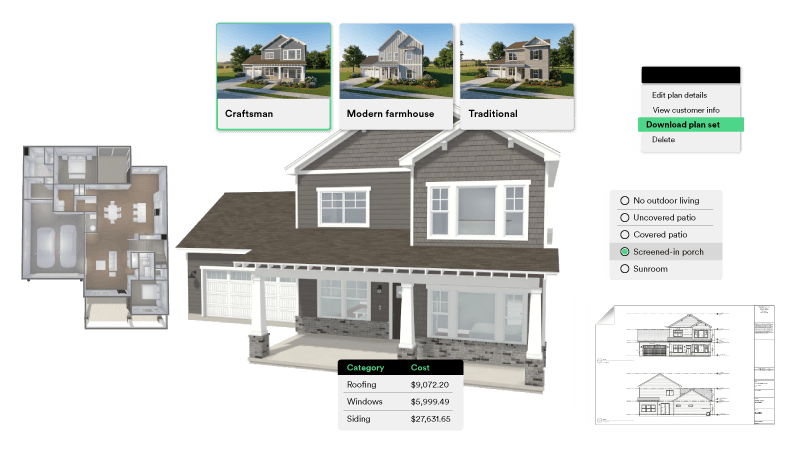
- Production and semi-custom homebuilders wanting one unified modelDesign, sales visualization, estimating and construction docs stay in sync automatically as changes are made.
- Builders scaling into new communities quicklyVendor-reported 50% reduction in time to open new communities suits builders prioritizing speed to market.
- Building-material distributors needing enterprise-scale takeoffsThe AI Estimating capability is specifically aimed at that use case.
- Builders wanting shoppable 3D visuals for buyer salesShowroom directly supports the sales/marketing side of the homebuilding process, not just design and construction.
- You build commercial, multifamily or other non-residential typologiesHigharc's platform is purpose-built specifically for single-family homebuilding.
- You need confirmed openBIM/IFC-native workflowsRevit, Archicad or Vectorworks offer more established, confirmed IFC export depth for cross-platform BIM exchange.
- You want published, self-serve pricingCompare against tools with transparent tiered pricing if a sales-led evaluation process isn't feasible for your timeline.
What does Higharc do?
An AI-native design-to-construction platform for homebuilders that generates homes as 3D spatial data, unifying design, sales visualization, cost estimation and construction documentation.
How much funding has Higharc raised?
More than $170 million total, including a $95 million Series C announced June 30, 2026, led by Insight Partners.
Who uses Higharc?
Named customers include Signature Homes, Ashlar Homes, New Home Inc., Legacy Design Homes, United Built Homes, Buffington Homes and Epcon Communities.
What is the US LBM partnership?
A strategic agreement announced alongside Higharc's Series C, extending Higharc's platform to the largest private U.S. lumber and building-materials distributor.
How much does Higharc cost?
Pricing is not published -- interested homebuilders need to contact sales directly.
