OpenSpace
Visual site-documentation platform that turns 360° walkthrough captures into a searchable, BIM-linked record of jobsite progress.
OpenSpace is a construction-site documentation platform founded in 2017 in San Francisco by Jeevan Kalanithi, Philip DeCamp and Michael Air, built around automated 360-degree photo capture of job sites, mapped directly onto floor plans and BIM models so project teams can visually navigate a site's history the same way they'd walk it in person. The founding team's earlier company, Sifteo, was a computer-vision-based interactive gaming-blocks startup acquired by 3D Robotics -- computer-vision and spatial-mapping expertise that carried directly into OpenSpace's core capture technology.
The core workflow is simple by design: a superintendent walks the site with a 360-degree camera (often mounted on a hard hat or handheld rig), and OpenSpace's software automatically stitches and maps that footage onto the project's floor plan, creating a searchable, date-stamped visual record that any team member can navigate remotely without needing to be on-site.
That visual documentation approach solves a genuinely common construction pain point directly: disputes over what was actually built, when, and in what condition are common on complex projects, and having a comprehensive, automatically-organized photo/video record substantially reduces the time and ambiguity involved in resolving them after the fact.
The company has raised substantial venture funding (over $100 million across rounds including a notable Series D) and named users include major general contractors -- reflecting genuine adoption specifically among large commercial and institutional construction programs where comprehensive site documentation has real risk-management and dispute-resolution value.
Beyond capture and viewing, OpenSpace has expanded into measurement and progress-tracking tools built on top of its captured visual data -- letting teams take approximate measurements directly within a captured photo and compare visual progress across different capture dates for the same location, extending the platform's role somewhat into territory that overlaps with dedicated progress-analytics tools like Buildots, while still centering on its core visual-documentation strength.
The company also emphasizes integration with existing project-management and CDE platforms (rather than positioning itself as a replacement for a full construction-management system), letting captured visual data link out to related RFIs, submittals or punch-list items tracked in a firm's primary project-management tool of choice.
Editor’s takeBIM•STACK editor's take: OpenSpace's automated 360-degree capture-and-mapping approach is a genuinely elegant solution to the tedious, inconsistent manual photo-documentation habits most job sites still rely on, and its substantial funding and GC adoption confirm real market validation. The tool's core value is documentation and dispute-resolution rather than active progress-tracking analytics (a role closer to Buildots or a construction-management platform), so firms should be clear on which specific problem they're solving before choosing between the two, and pricing requires a direct sales conversation.
OpenSpace's site-capture workflow is deliberately minimal -- walking the site with a 360-degree camera requires little training beyond establishing a consistent route and schedule, since the software handles stitching and floor-plan mapping automatically.
Navigating the resulting visual record (clicking through a floor plan to jump to any point in the site's photo history) is intuitive for most project team members immediately, since it mirrors how people already think about walking a physical site rather than requiring a new mental model.
Establishing a consistent capture schedule and route across a project's full duration is more of an organizational discipline than a software-training challenge -- firms that get the most value tend to assign clear ownership of the weekly (or more frequent) capture routine to a specific site team member, rather than treating it as an occasional, ad hoc task.
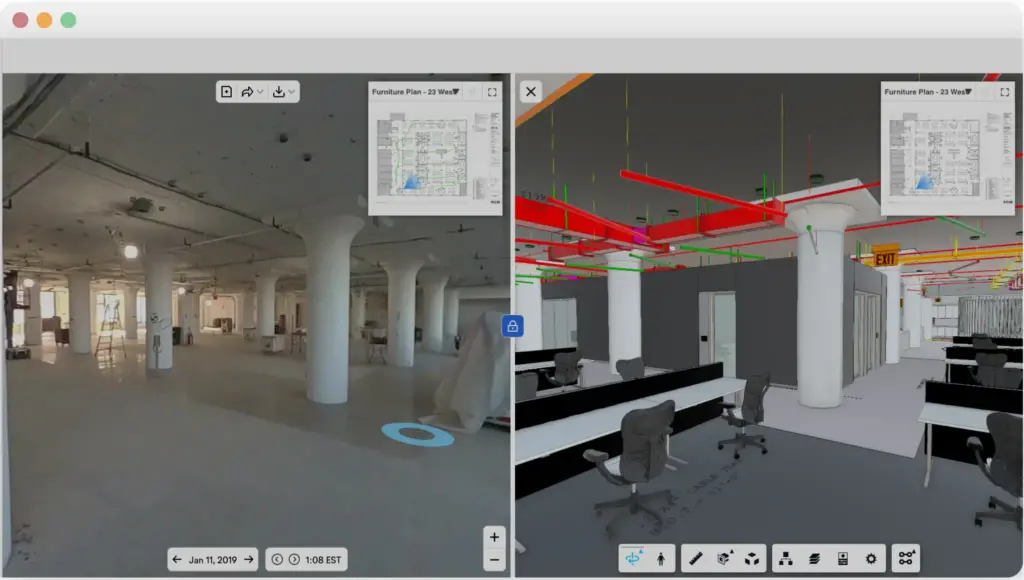
- Large commercial and institutional construction programsComprehensive documentation has the most risk-management value on complex, high-stakes projects.
- General contractors managing dispute and risk exposureA comprehensive, date-stamped visual record substantially eases what-was-built-when disputes.
- Teams needing remote site visibilityAny team member can navigate site history visually without being physically present.
- You need automated progress-versus-schedule analytics, not just documentationBuildots is built specifically for AI-driven comparison against the BIM model and schedule.
- You need published, self-serve pricingCompare against tools with transparent tiered pricing if a custom sales conversation isn't feasible for your timeline.
- Your projects are small enough for simpler manual photo documentationA lighter, non-automated photo-log approach may be sufficient without OpenSpace's full capture infrastructure.
What is OpenSpace used for?
Automated 360-degree construction-site photo/video documentation, mapped onto floor plans and BIM models for visual site history navigation.
How does OpenSpace capture site data?
A superintendent walks the site with a 360-degree camera; the software automatically stitches and maps the footage onto the floor plan.
How much does OpenSpace cost?
Pricing isn't published -- contact sales directly for a quote.
Who founded OpenSpace?
Jeevan Kalanithi, Philip DeCamp and Michael Air founded it in 2017 in San Francisco.
Is OpenSpace the same as Buildots?
No -- OpenSpace focuses on comprehensive visual site documentation, while Buildots focuses on automated AI comparison of built progress against schedule.
