
Pliera
Rule-based building configurators from NeoBIM GmbH (founded by Enscape co-founder Moritz Luck) — its Gen tool turns a German residential plot's address into a zoning-checked feasibility study with costs and returns. Formerly os.build / neoBIM buildOS.
Pliera is the current name of the product NeoBIM GmbH previously sold as os.build, and before that as neoBIM buildOS -- the old os.build address and every one of its tool pages now redirect to pliera.com. The rebrand came with a narrower story. os.build was a suite of four separate tools (Gen for site feasibility, Tender for bid comparison, Insider for German municipal monitoring and Mind for project knowledge); Pliera drops Tender, Insider and Mind from its site entirely and repositions around one idea: turning the rules behind a building type -- company standards, modules, adjacencies, cost logic and engineering constraints -- into a reusable configurator, so a team can adapt and validate whole series of buildings across different sites rather than designing each one from scratch.
The company behind it is unchanged. NeoBIM GmbH is registered in Karlsruhe, Germany (company register HRB 749693, Amtsgericht Mannheim), with Moritz Luck as Managing Director and Dr.-Ing. Florian Marthaler as authorised signatory (Prokurist), per Pliera's own imprint. Luck's earlier credential is the reason the company draws attention: he co-founded Enscape, the real-time rendering plugin that became one of the most widely adopted visualization tools in architecture before Chaos acquired it.
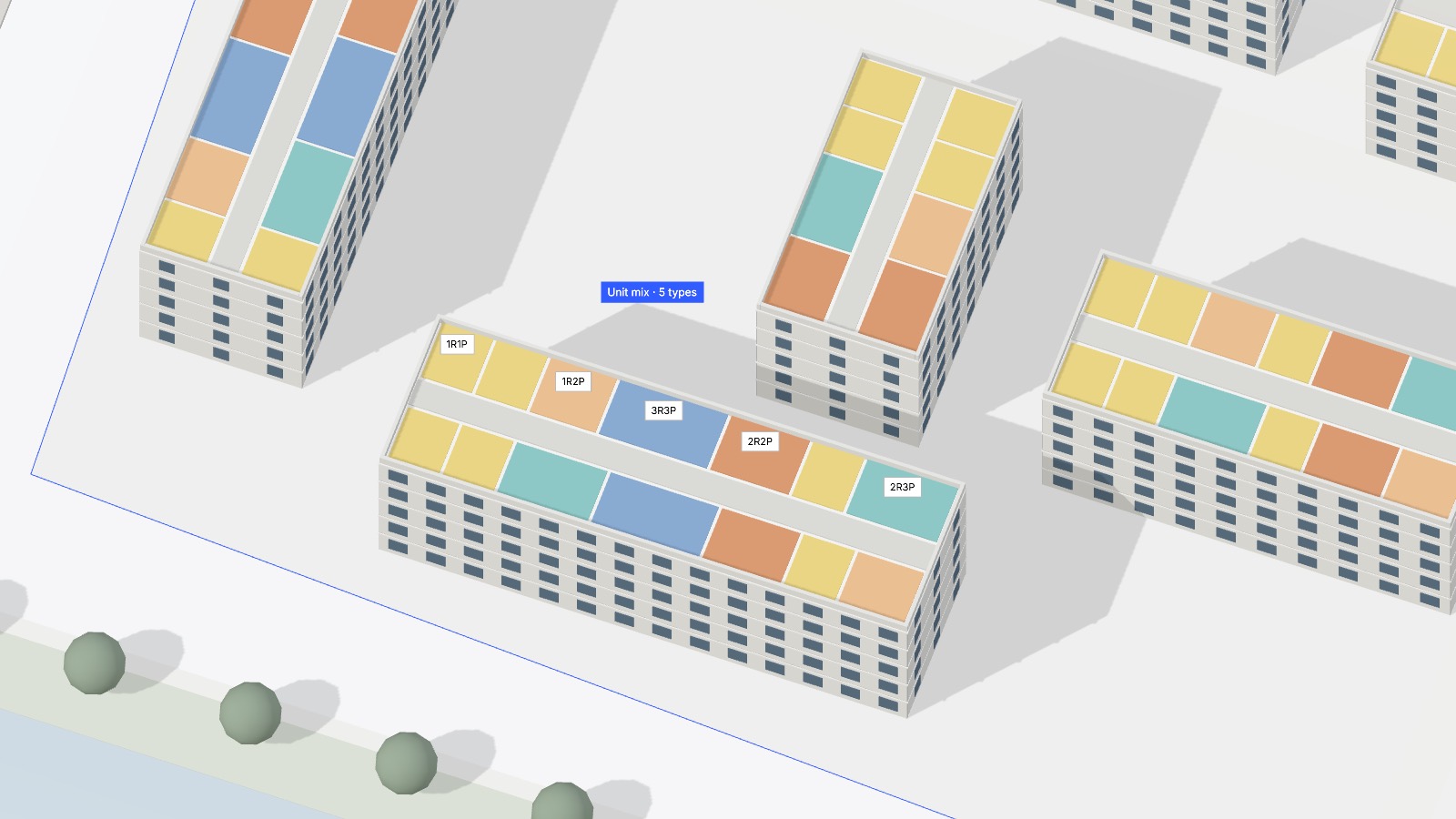
Gen, described as "the residential configurator," is the one product with a public page, a self-serve plan and published prices, and it currently covers residential sites in Germany. You enter an address; Gen pulls zoning, density and parcel geometry, places buildings on the plot and checks each against zoning, density and coverage limits as it goes. A single run produces ten massing variants ranked by gross floor area, efficiency and lot coverage, and the apartment mix can be shifted by share (studios versus family units) while every option stays compliant. Buildings can be moved, resized or redrawn by hand with setbacks and figures updating live, and firms can upload their own standard floor plans so Gen plans with those instead of generic ones.
Each scheme comes with a business case: sale prices and rents by location from a market-data partner, build costs from reference projects by trade, and every number editable, ending in net profit and return on equity. Outputs include photorealistic renderings for an investor deck and an export to Revit, IFC and PDF storey by storey, so the architect starts from the chosen scheme rather than from zero. Gen's own page demonstrates all of this on a 12,752 m² plot in Hamburg.
Pricing for Gen is published: Starter at €99/month for 20 feasibility reports a month (self-serve, PDF export), Pro at €499/month adding your own floor plans and Revit families, higher report volume, priority support and Revit/IFC export, and a custom-quoted Enterprise tier. A free plot check is offered from the same page. Beyond Gen, Pliera shows configurators for other building types -- high-rise residential, hotels, data centers, supermarkets, wind towers, bridges and modular structures -- but these are presented as demos of what a custom configurator could be, sold through a sales conversation, and the site also points to a separate "rule-based BIM tool" with no public detail or pricing yet.
Editor’s takeBIM•STACK editor's take: Pliera is a cleaner, more focused pitch than os.build was -- one clear thesis (encode a building type once, generate it for any site) instead of four loosely related tools. Gen is a genuinely useful idea for developers deciding whether a German residential plot is worth buying, collapsing zoning checks, massing and a pro forma into minutes, and Luck's Enscape track record counts for something. But this is the product's third name in roughly two years, the only published proof is a first-name testimonial and a recorded demo, and Gen is limited to German residential projects. Treat it as an early-stage bet worth piloting on a real plot, not a proven platform to build a workflow around.
Gen is built around guided input rather than modeling: type an address, review the generated variants, adjust the unit mix or drag a building, and read the updated compliance and financial figures. Developers and planners who already think in terms of gross floor area, density and returns should be productive within a first session, since nothing has to be modeled by hand and every figure is labeled in the vocabulary of a feasibility study.
The steeper part is everything beyond Gen. A custom configurator means translating a firm's own standards, modules and cost logic into explicit rules with NeoBIM's team, which is a consulting-style engagement rather than a self-serve setup. And because the product has been renamed twice, anyone researching it should evaluate what is live on pliera.com today rather than descriptions of buildOS or os.build found elsewhere online.
- Developers screening German residential plotsGen answers what can be built, what it costs and what it earns before a single fee is spent on a site.
- Firms that build in seriesCompanies repeating a building type across many sites can have their standards encoded once as a custom configurator.
- Teams that want feasibility to feed straight into BIMRevit and IFC export on Pro means the winning scheme becomes the architect's starting model.
- Early adopters comfortable with an evolving vendorFirms willing to accept a young, recently repositioned company in exchange for early access to a focused tool.
- You need site feasibility outside GermanyTestFit or Giraffe cover generative massing and feasibility with broader geographic use and longer track records.
- You need full BIM authoringRevit, Archicad, Qonic or Motif author and document buildings -- Pliera's public product is a feasibility configurator.
- You relied on os.build's Tender, Insider or MindThose tools are no longer on Pliera's site; bid-comparison or knowledge-management needs are better served by established tools in those categories.
- You want to avoid repositioning riskA company that has changed its product name and lineup twice in two years carries more roadmap uncertainty than an established vendor.
Is Pliera the same as os.build and neoBIM buildOS?
Yes -- all three are products of NeoBIM GmbH in Karlsruhe. os.build's address and tool pages now redirect to pliera.com, which is the current name.
What happened to Tender, Insider and Mind?
They are no longer on Pliera's site; their old os.build pages redirect to Pliera's homepage. Gen is the one tool carried over, now as "the residential configurator."
Who founded Pliera?
NeoBIM GmbH, incorporated in Karlsruhe, Germany in January 2024. Its Managing Director is Moritz Luck, who previously co-founded Enscape, the real-time rendering plugin later acquired by Chaos.
What does Gen do?
From a German residential plot's address it pulls zoning, density and parcel data, generates ten zoning-checked massing variants, builds a business case (sales value, costs, return on equity) and exports renderings plus Revit, IFC and PDF files.
How much does Pliera cost?
Gen is €99/month (Starter, 20 reports a month) or €499/month (Pro, with your own floor plans, Revit families and Revit/IFC export); Enterprise and custom configurators are quoted. A free plot check is available.
Does Pliera work outside Germany?
Gen's automatic zoning and parcel data currently covers German residential sites. Configurators for other building types and markets are offered as custom work through sales.
